Posts

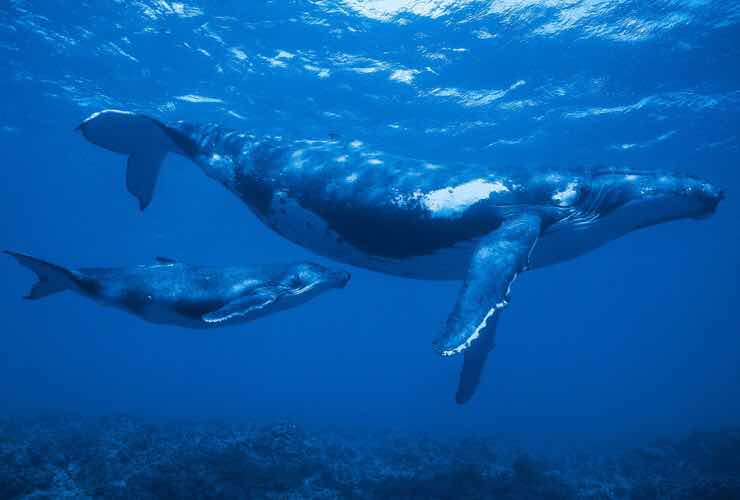
Whales breastfeed their young ones with milk
Image
J ust  like every other mammals, Whale’s which is considered the biggest animal on earth feed their young ones with breast milk even while inside deep waters. Surprisingly, mother whale which is also known as “Cow” feed their calves (baby whale) without nipples. Mother whale do not have nipples, they are only able to release milk to young ones through their ‘mammary slits’- a special folds of skin that enclose the feeding glands. Though researchers are not completely sure how they do it, it is believe that either the calves can curl their tongues into a tube-like shape to fit its mother feeding gland to release milk, or that specialised muscles (mammary silt) actually contract the mammary glands, squeezing milk directly into the calf’s mouth. The blue whale has the largest mammary glands on Earth, each gland is about 1.5m long in comparison weighs as much as a baby elephant. Blue whale mothers can produce 200 litres of milk per day with a fat content of 35-50%. Such percenta...

Akwa-Ibom; The Promise Land

Image
A kwa-Ibom a state in southern Nigeria close to the Atlantic ocean seems to be the fastest developing city in Nigeria. With quite a number of world class infrastructure, the state seems to attract a vast number of visitors daily. What is the state best known for?  There are good number of characteristics the oil rich State is noted for, since it is still developing, the state qualities keep increasing in every blink of the eyes. Akwa-Ibom characteristics can be seen differently by different people. In an effort to generalize this qualities, the undermentioned will comprise of my personal noted characteristics of the oil rich state. 1. Hospitality: You can't mention Akwa-Ibom without mentioning hospitality. Akwa-Ibom is noted for its hospitality both as an act of service and a business of service. The state seems to be the most welcoming state in Nigeria, Africa most populated country. Its act of service to it's visitors is deep rooted in the bloodstream of the locals, as a res...

Crown shyness a form of social distance among trees

Image
M any trees maintain mysterious social distance among themselves in other to stay healthy, just like it was observed by humans during Covid-19. This phenomenon is referred to as crown shyness. Crown shyness, also known as canopy disengagement is an amazing natural phenomenon where the crowns of trees appear to avoid each other. Scientists studying trees with this concept suggest that crown shyness may be caused by the trees' growing tips being able to sense light and so stop growing when they are near to the foliage of neighbouring trees. Research further shows that plants can detect a frequency of visible light called far-red light, which can tell them how close they are to their neighbours. They can also use the blue light in the spectrum to avoid growing into the shade. Just like animals, plants also compete for resources such as: nutrients, water, space and light to survive. In forested areas with dense canopies there is intense competition between plants. It is possible that g...

Switzerland yearly President

Image
U nlike many other democratic countries in the world, the president of Switzerland is not directly elected by their citizens and their president are elected annually. If you have never lived in Switzerland, you may find it difficult to understand the process of their political system. So stay calm and don’t get confuse as I take you through the intricacies of Swiss government. Switzerland political system is federal in nature and based on semi-direct democracy. Switzerland is a federal state with three political levels: the federal government, the 26 cantons (state or district) and almost 2,636 communes (small district) across the country. The Federal Assembly, comprise of 200 elected members of the National Council (the 'lower chamber', representing the commune) and 46 elected members of the Council of States (the 'upper chamber', representing the cantons), these political class are the electorate who elects the President from members of the federal council. The Federa...

Bazalgette sewers still serving London

Image
T he London sewers was constructed 167 years ago by a man called Joseph William Bazalgette. This man designed the London sewers which is regarded as the greatest engineering construction in the 19th century. Before he was contracted in 1860, the city of London depend solely on the "night soil collector" to path away with their waste which was empty into the old city river.  London had a very big sewage problem and it got even worst when wealthy family poo was empty into the rivers directly through flush toilet which usage was increasing rapidly.  As London sewage issues got worst and unbearable in 1858, (referred to as the "Great stink") the city became very unconducive for living. The human effluent and industrial waste deposited in the Thame river was the cause for Cholera and typhoid fever that swept through the population. The situation called for a rapid construction of a new massive sewer schemes all round the city. Joseph William Bazalgette was the Chief Engi...