Crown shyness a form of social distance among trees

Many trees maintain mysterious social distance among themselves in other to stay healthy, just like it was observed by humans during Covid-19. This phenomenon is referred to as crown shyness.
Crown shyness, also known as canopy disengagement is an amazing natural phenomenon where the crowns of trees appear to avoid each other. Scientists studying trees with this concept suggest that crown shyness may be caused by the trees' growing tips being able to sense light and so stop growing when they are near to the foliage of neighbouring trees.
Research further shows that plants can detect a frequency of visible light called far-red light, which can tell them how close they are to their neighbours. They can also use the blue light in the spectrum to avoid growing into the shade.
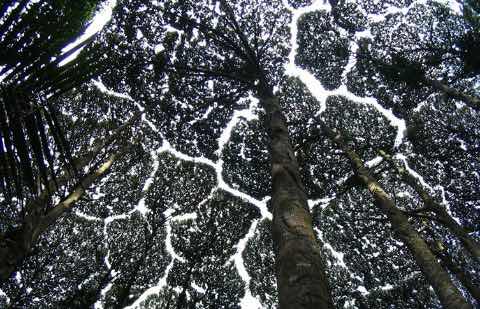
Just like animals, plants also compete for resources such as: nutrients, water, space and light to survive. In forested areas with dense canopies there is intense competition between plants. It is possible that gaps in the canopy resulting from crown shyness allows trees to increase their exposure to light and optimise the process of photosynthesis. Crown shyness also let light reach the forest floor, which are also beneficial to not too tall plants.
Additionally, by having branches that do not physically touch those of their neighbours, trees may be able to limit the spread of harmful leaf-eating insects and potentially also the transmission of harmful diseases from tree to tree.
Crown shyness doesn't occur between all trees. It has been documented to occur in black mangrove (Avicennia germinans), lodgepole pine (Pinus contorta), Japanese larch (Larix kaempferi), some species of eucalypt and several other species. You may likely not observe this behavior if you look from above. It is usually best seen from the ground in places where there is little undergrowth obscuring the view up to the treetop.

Comments
Post a Comment